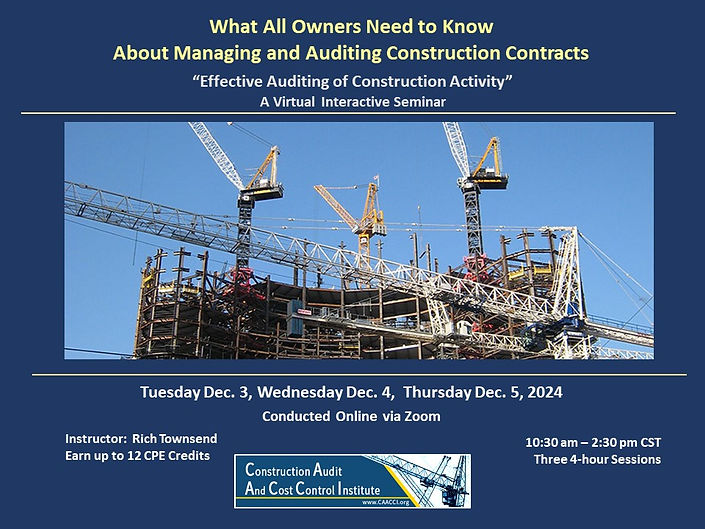
Construction Audit Seminar - Virtual - December 2024
This interactive virtual seminar will be conducted via Zoom in three 4-hour sessions. Managing construction activity effectively for large complex projects requires experience and special knowledge. Attendees will learn some of the most important ways to improve their construction contracting methodologies to mitigate some of the significant mistakes Owner organizations often make which can cost them millions of dollars in excess construction costs.
Earn 12 NASBA-Approved CPE credits.
Program Schedule
Part 1: Tuesday - December 3, 2024 - 4 hours - 4 CPE (10:30 am to 2:30 pm CST)
Part 2: Wednesday - December 4, 2024 - 4 hours - 4 CPE (10:30 am to 2:30 pm CST)
Part 3: Thursday – December 5, 2024 - 4 hours – 4 CPE (10:30 am to 2:30 pm CST)
All sessions will be held via Zoom
10:30 am - 2:30 pm CST - Presented from Dallas, TX
8:30 am - 12:30 pm PST
11:30 am - 3:30 pm EST
This is a live presentation only. Any recordings made will be for our records only.
Who Should Attend
-
Owner's construction management executives
-
Owner project managers
-
Owner contract administrators
-
Owner construction contract procurement representatives
-
Owner legal representatives
-
Owner's construction audit representatives (internal audit and/or external consultants)
Types of Contracts Covered
The course will emphasize effective construction audit strategies and construction cost control techniques for projects involving the use of the following types of construction contracts:
-
Cost plus FEE - Construction Manager at Risk- Guaranteed Maximum Price (GMP) contracts
-
Cost plus FEE - Design-Build GMP contracts
-
Cost plus FEE contracts with General Contractors (with or without a GMP)
-
Cost Plus FEE contracts with major subcontractors/trade subcontracts (with or without a GMP)
-
Lump sum and/or Unit price trade subcontracts or prime construction contracts
Attendees Will Learn
-
How to avoid making costly mistakes when entering into construction contract agreements
-
Key steps to help ensure the best value is received when the CM/GC contracts with subcontractors
-
Critical process to ensure subcontractor change orders are fairly priced
-
Process to control costs related to materials purchased by the Contractor
-
How to structure your contract to limit exposure to potential excessive billings for contractor-owned equipment
-
Possible overcharges for third party equipment to watch out for
-
How to avoid making excessive payments for Subguard® (Subcontractor Default Insurance) and/or Contractor Controlled Insurance Programs (CCIP)
-
Methods to effectively minimize the loopholes in contracts that create opportunities for contractors to realize excessive hidden profits
-
Management/construction audit partnering strategies to ensure construction cost controls are working as anticipated to benefit the project
-
Owner's Project Managers will learn specific problems to watch out for when managing their projects to avoid significant overpayments to their construction contractors
-
Owner's Project Managers will learn how to effectively partner with their construction auditors to prevent significant overcharges and/or overpayments going undetected
Learn The Pros and Cons of
-
Cost reimbursable pre-construction services versus Lump Sum payments for pre-construction services
-
Pre-established labor billing rates versus reimbursement of actual wages and verifiable labor burden
-
Lump sum general conditions versus cost reimbursable general conditions
-
Lump sum self-performed contractor work versus cost plus fee with GMP for self-performed contractor work
-
Converting GMP contracts to lump sum contracts
-
Supported payment applications versus percentage of completion payment applications
-
Pre-agreed labor burden percentages versus reimbursement for actual defined labor burden costs
-
Bonding both the prime contractor and the subcontractors
-
Subcontractor default insurance aka Subguard® versus conventional performance and payment bonds
-
Savings Sharing clauses versus no savings sharing clauses
-
Worker's Compensation and General Liability Insurance - Conventional insurance versus Contractor-Controlled Insurance Programs (CCIP)
-
Worker's Compensation and General Liability Insurance - Conventional insurance versus Owner Controlled Insurance Programs (OCIP)
Other Learning Points To Be Covered
-
Typical contractor fees for cost plus fee with GMP construction manager/general contractor projects of various sizes
-
Whether or not to reimburse for general liability insurance or have it covered by Fee
-
Typical charges for general liability insurance
-
Typical charges for Subcontractor Default Insurance (Subguard®)
-
Typical charges for Contractor Controlled Insurance Programs (CCIP)
-
Typical charges for worker's compensation when the contractor is self-insured and/or uses high deductibles
-
Change order markup percentages allowed on subcontractor self-performed work and work performed by sub-subcontractors
-
Actual material pricing and labor analysis for trade subcontract change orders
Course Outline
Introduction to Effective Auditing of Construction Activity
-
Audit objectives related to controlling construction costs
-
Project team roles and responsibilities
-
Delivery systems - fast track, design build, conventional
-
Contract procurement methods, types, and phases
Cost Plus and Time and Material Contracts - Typical Overcharges
-
Design contract billings for time and reimbursables
-
Billings for personal computer and/or mainframe computer time
-
Construction contractor and/or construction manager billings for labor and labor burden
-
Billings for contractor-owned equipment, third-party equipment rental, expendable tools, equipment and
-
consumables, and material used during construction
-
Transactions dealing with subcontractors
Auditing Construction Change Orders
-
Typical overcharges in lump sum change orders
-
Electrical change order - discussion exercise
-
Change order labor and labor burden pricing
Auditing Lump Sum or Unit Price Contracts
-
Quality and scope of work overcharges
-
Substitution of materials or methods
-
Not performing required services
-
Not installing proper quantities
-
Special types of lump sum contract overcharge situations
-
Adjusting allowances
-
Required bonds and insurance
-
Improper charges for sales tax
-
Special unit price overcharge situations
-
Excessive quantities billed
-
Improper measurement method used
-
Inaccurate measurements
-
Billings for excessive quantities actually performed
Program Fee
Regular Registration Fee = $995.00
Program fee includes instruction and all program materials.
CPE
All participants are eligible to receive up to 12 Continuing Education Credits (CPE’s) to fulfill professional accreditation requirements. Participants will receive 1 CPE credit for every 50 minutes in attendance. Field of Study: Auditing. Course Level: Basic. Group-Internet, lecture-style seminar; no prerequisites or advanced preparation required.
Instructor
Rich Townsend is Co-Owner of the consulting firm R. L. Townsend & Associates, LLC. The firm provides construction audit and construction cost control advisory services to a wide variety of organizations throughout the United States.
Mr. Townsend is a Certified Internal Auditor (CIA), a Certified Public Accountant (CPA), and a Certified Construction Auditor (CCA). He currently serves on the advisory board for The National Association of Construction Auditors. He has been providing professional development training seminars through the Construction Audit & Cost Control Institute, Inc. since 2008.
He is a graduate of Waynesburg University (Waynesburg, Pennsylvania) where he obtained a Bachelor of Science Degree with a major in accounting.